When Beauty Becomes Biological
The Structural Evolution of Precision Care
The End of Accumulation
The future of beauty is not louder formulas or longer routines.
It is precision – applied quietly.
For decades, the beauty industry advanced through accumulation. More products. More steps. More claims layered onto already complex routines.Progress was often measuredbynovelty rather than understanding.
This logic was not accidental. It reflected the limits of what could be known. Without access to individual biological insight, approximation became the only workable model. Categories such as age, skin “type,” and lifestyle served as substitutes for something far more complex: how skin actually functions at a molecular level. Yet biology has always resisted simplification.
Human skin does not behave uniformly, nor does it respond predictably to standardized interventions. Two individuals of the same age, following identical routines, may experience entirely different outcomes – not because one made better choices, but because their biological predispositions are fundamentally different. As scientific tools become more precise, this discrepancy becomes impossible to ignore.
Why Approximation Dominated for So Long
Before biological data was accessible, categorization was efficiency. The beauty industry relied on observable groupings:
• Chronological age
• Oily vs dry
• Sensitive vs resilient
• Urban vs rural lifestyle
These categories were not inherently flawed. They were pragmatic. Mass manufacturing requires simplification. Retail distribution rewards clarity. Marketing systems thrive on segmentation. But segmentation is not personalization.
From a biological standpoint, skin is governed by genetic polymorphisms influencing collagen synthesis, antioxidant capacity, inflammatory response, glycation susceptibility, barrier protein expression, melanin regulation, and dozens of other pathways.
Two 40-year-old individuals categorized as “dry skin” may carry fundamentally different genetic predispositions affecting:
• Matrix metalloproteinase activity
• Filaggrin expression
• Elastin fiber resilience
• Reactive oxygen species handling
Without genomic access, approximation was the only scalable model. Today, that constraint is dissolving.
The Psychological Architecture of the Beauty Industry
Long before biological precision became possible, persuasion filled the explanatory vacuum. Daniel Kahneman’s Nobel price winning framework of System 1 and System 2 thinking offers a useful lens.
Traditional beauty marketing operates largely in System 1:
• Visual appeal
• Emotional aspiration
• Sensory pleasure
• Social proof
• Urgency
Fast cognition. Low friction. Immediate response. In environments of biological uncertainty, emotional logic becomes efficient. Consumers do not choose irrationally – they choose within available cognitive structures.
But as biotechnology enters the consumer domain, decision-making shifts. Consumers begin engaging System 2:
• Analytical evaluation
• Ingredient scrutiny
• Scientific plausibility
• Long-term logic
The shift from “Does it feel transformative?” to “Does it align with my biology?” reflects broader cultural maturation. Beauty moves from symbolic identity to informed alignment. This transition does not eliminate emotion. It integrates it with evidence.
From Approximation to Precision
The transformation now taking place in beauty is not aesthetic. It is structural. Advances in genetics, biotechnology, and algorithmic systems allow care to move beyond averages and toward biological specificity.
Instead of asking what generally works, precision systems ask:
• Which pathways dominate this individual’s aging trajectory?
• Where is oxidative stress vulnerability higher?
• How robust is collagen synthesis potential?
• Is inflammatory response heightened or balanced?
Precision narrows intervention. It does not intensify it.
Where mass systems experiment through layering – retinol over peptides over acids over antioxidants – biological alignment asks a quieter question:
What is necessary? And equally important – what is unnecessary? Restraint becomes intelligence. Beauty begins to listen before it acts.
Genetics Within Cosmetic Boundaries
Genetic information must be handled with discipline. Consumer cosmetic systems operate within strict regulatory boundaries. They do not diagnose disease. They do not treat pathology. They do not intervene medically.
Instead, they interpret predispositions – probabilistic tendencies influencing structural protein turnover, antioxidant enzyme function, glycation susceptibility, pigmentation pathways, and inflammatory signaling balance.
Genetic onboarding in a cosmetic context serves three purposes:
1. To clarify biological variability
2. To reduce unnecessary ingredient exposure
3. To align formulation logic with structural predispositions
It does not predict outcomes.
It informs probabilities. This distinction is essential – scientifically, ethically, and legally. Precision without boundary is recklessness. Precision within boundary is discipline.
Neuroplasticity and the Identity of Aging
Norman Doidge’s work on neuroplasticity revealed that the brain is not fixed; it reorganizes in response to experience. Perception of aging operates similarly.
For decades, beauty language framed aging as deterioration requiring correction. This narrative shaped identity – subtly reinforcing anxiety, urgency, and comparison.
Biological literacy changes that framing. Aging is not uniform decay. It is gene-environment interaction expressed over time. Some individuals carry predispositions for:
• Slower collagen degradation
• Stronger antioxidant defense
• Lower inflammatory sensitivity
Others may have increased vulnerability in specific pathways. When individuals understand their unique predispositions, anxiety becomes specificity.
Identity shifts from: “I am aging badly.” to “My biology expresses aging in a particular way.”
Personalization reduces generalized fear. It increases targeted awareness. This is not cosmetic transformation. It is cognitive reframing supported by biological insight.
Technology That Learns Where to Stop
Artificial intelligence in biotechnology is often associated with acceleration – faster, stronger, more dramatic. Its highest function in consumer biology is constraint.
AI can model interactions. It can map correlations. It can flag redundancies. But in responsible systems, its role is not escalation. It is elimination.
By identifying which pathways require support and which do not, algorithmic systems reduce unnecessary layering. In high-functioning biological ecosystems, excess intervention can destabilize equilibrium.
The most sophisticated system is not the most aggressive. It is the most selective. Technology’s future in beauty is not spectacle. It is subtlety.
The Economics of Individualization
Mass beauty thrives on standardization. One formula. Millions of units. Global distribution. Cost efficiency scales downward. Biological personalization reverses that structure.
Genetic onboarding requires:
• Laboratory processing
• Data interpretation
• Algorithmic modeling
• Controlled formulation variation
• Logistical complexity
The economic value lies in infrastructure, not volume.
My favorite digital marketer for years, Neil Patel, often emphasizes that in digital ecosystems, the greatest value sits in systems – data architecture, algorithmic intelligence, and optimization frameworks – not surface outputs.
The same logic applies here. The bottle is visible. The biological interpretation system is not. Pricing must reflect process, not packaging. Genetic onboarding is not a product accessory. It is foundational architecture. Luxury consumers intuitively understand invisible value when transparency clarifies logic.
A Redefinition of Luxury
Luxury historically signified excess. Later, craftsmanship. Then minimalism. Today, luxury increasingly signifies intelligence. In information-rich environments, discernment becomes status.
Daniel Goleman’s concept of emotional intelligence emphasizes self-awareness and self-regulation as markers of maturity. Modern luxury consumers do not seek abundance. They seek alignment.
Biological personalization reframes luxury as:
• Reduced experimentation
• Reduced noise
• Reduced redundancy
• Increased clarity
Precision replaces volume. Understanding replaces persuasion. What distinguishes advanced systems is not what they add, but what they consciously exclude.
Where Beauty Is Heading
This shift is not speculative. Across biotechnology, health optimization, and data-driven consumer platforms, personalization is becoming structural rather than optional.
In beauty, this evolution will separate three models:
1. Traditional mass formulation
2. Marketing-driven “personalization” (quiz-based, surface-level)
3. Biology-informed precision systems
The third model requires scientific discipline and ethical clarity. It will scale slower. It will cost more. It will operate within tighter boundaries. But it will build deeper trust. The competitive advantage of the future will not belong to noise amplification. It will belong to structural coherence.
A System Built on Understanding
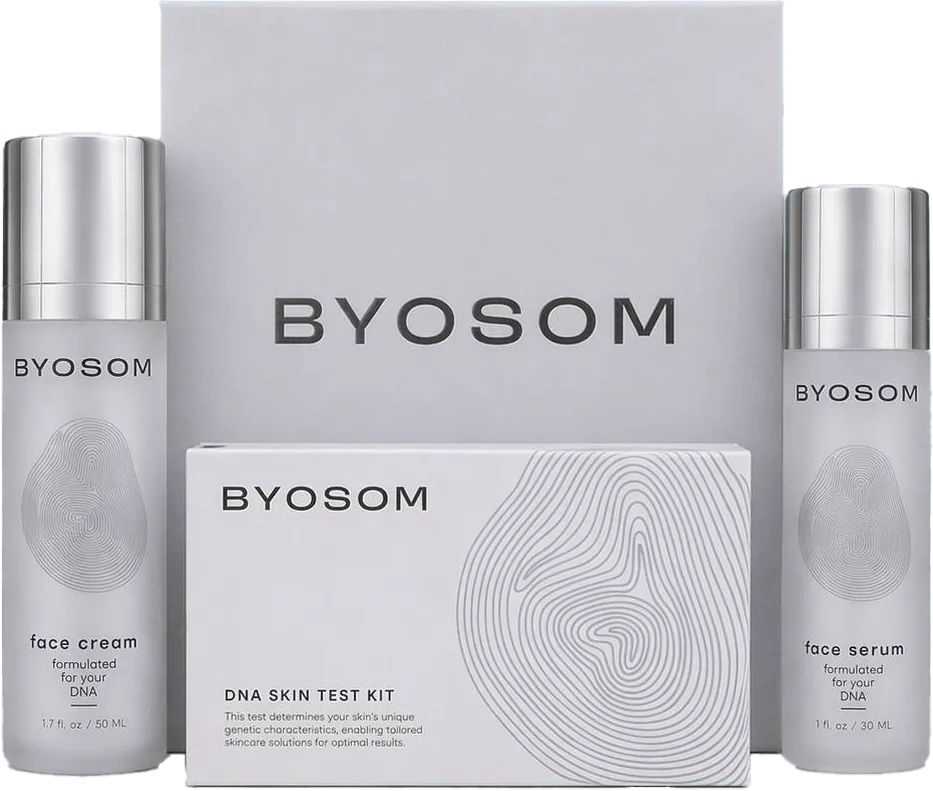
Within this structural transition, BYOSOM represents a departure from conventional cosmetic sequencing. Rather than beginning with product selection, the system begins with genetic onboarding.
Individual genetic markers associated with skin structural dynamics are analyzed within cosmetic relevance boundaries. These include predispositions related to collagen architecture, antioxidant handling, inflammatory modulation, glycation sensitivity, and barrier resilience.
These insights inform formulation logic – not to treat, not to diagnose, but to align. Strict regulatory, ethical, and scientific limits define scope. The system does not promise reversal. It does not predict outcomes. It does not medicalize beauty. Its function is clarity.
Understanding how an individual’s skin is predisposed to behave allows formulation discipline rather than formulation experimentation. BYOSOM does not attempt to disrupt through spectacle. It aligns with a broader reorientation — from correction to continuity, from persuasion to precision.
Beauty, Reconsidered
As beauty becomes biological, its language grows quieter. Less performative. More deliberate. More measured. The emphasis shifts:
• from fixing perceived flaws, to respecting biological individuality
• from resisting time, to understanding structural expression
• from louder formulas – to systems that know where to stop
This evolution does not reject beauty’s past. It refines it. Not through spectacle. Not through accumulation. But through precision – applied quietly.
About BYOSOM
BYOSOM is a biotechnology-driven cosmetic system built around genetic onboarding and biologically aligned formulation. Operating strictly within cosmetic regulatory frameworks, the platform emphasizes clarity, restraint, scientific discipline, and long-term structural understanding over trend-based claims.
Invisible code. Visible beauty.
Author Bio
The author is the founder of BYOSOM.